

Home › Aquarium & pond › Drop test
Category
Aquarium drop test: precise single values
Test the most important values for your aquarium yourself.
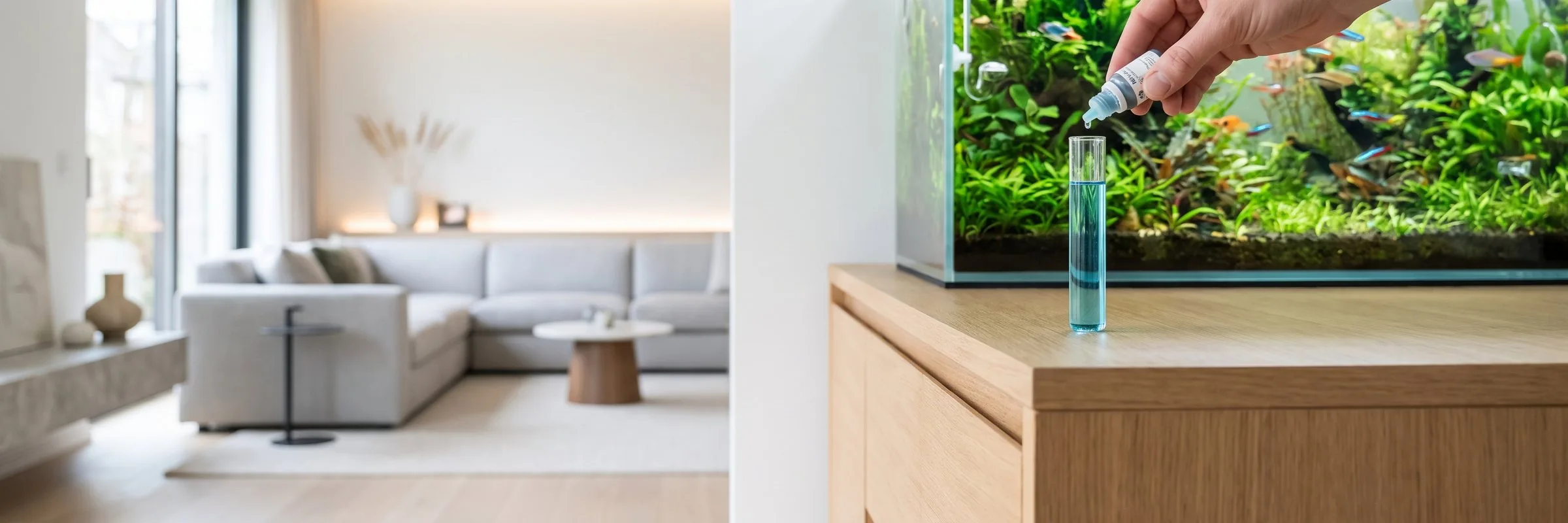
Fill the test tube with aquarium water up to the mark.
Add the specified number of reagent drops and swirl gently.
Wait a moment until the colour has fully developed.
Compare the colour with the enclosed scale.
In an aquarium drop test, you fill a vial with tank water, add reagent drop by drop and compare the resulting colour with a scale. Drop tests are considered more accurate than test strips, especially for low but critical nitrite and ammonium levels. There are individual sets for pH, KH, GH, ammonium, nitrite, nitrate and phosphate.
Good to know
These values matter
The key values for lively fish, clear water and few algae at a glance.
Test every time
too lowacidic — fish under stress
too highalkaline — ammonia turns more toxic
Tipwater change, keep KH stable
too lowpH tips easily (pH crash)
too highpH hard to lower
TipKH-Plus or water change
Fish & plants
too lowharmless, no lower limit
too hightoxic — especially at high pH
Tipwater change now, check filter
too lowharmless, no lower limit
too highhighly toxic to fish
Tipwater change, feed less
When needed
too lowharmless, no lower limit
too highfeeds algae, stresses fish
Tipchange water regularly, add plants
too lowtoo soft for many fish
too hightoo hard for soft-water species
Tipmatch to your fish stock
Aquarium & pond advisor: what to do when a value is offAquarium test strips: several values in one stepHow to test aquarium water: values and timing

Pure water — not just in the pool
From reverse osmosis to water testing: water expertise from a single source.
To smardy blueQuick answers
Common questions
In a drop test, you put a water sample into a vial and add reagent drop by drop. The water changes color, and the color indicates the value, which you compare against a scale. This method is more accurate than test strips and is especially popular in the aquarium for critical values such as nitrite.
Yes, drop tests are considered more accurate in the aquarium because the colour reaction in the water sample is more pronounced and can be read more precisely. This matters especially with low but critical nitrite or ammonium levels. For a quick overview, test strips remain handy; for exact individual values, many aquarists reach for the drop test.
For drop tests there are individual sets for each value: pH value, carbonate hardness, total hardness, ammonium, nitrite, nitrate and phosphate. This lets you check exactly the value that matters at that moment – nitrite during cycling, for instance. Many aquarists combine several individual tests into a personal set for their tank.
In an established aquarium, a weekly check of the most important values is usually enough. When cycling a new tank, daily measurements of ammonium and nitrite make sense until the nitrogen cycle is running stably. After stocking changes, medication treatments or problems, a targeted drop test of the affected value is also worthwhile.
Follow the instructions exactly: the right number of drops, rinse the vial thoroughly between tests and read off the colour against a light, neutral background. Shake the reagent bottles if instructed. Store the reagents in a cool, dark place and check the expiry date so that your results stay reliable and comparable.
Drop tests are especially worthwhile for demanding tanks such as aquascapes, discus or shrimp aquariums, and for every newly cycled aquarium where nitrite and ammonium need to be monitored closely. If you only occasionally need a rough overview, test strips will serve you well; but when it comes to precision, there's no way around the drop test.
Help or advice — feel free to get in touch
Phone: 0800 8727 739
Real people no hold queue — we’re here for you personally.
Mon–Fri 9:00–15:00 · free of charge
Email: info@smardy-blue.com
Drop us a line — we usually reply to every message personally within 24 hours.
Contact us
Still have a question? Through our contact form you’ll quickly find the right answer.