

Home › Pool & spa
Pool test kits for pool and hot tub
pH, chlorine & alkalinity under control — find the right test.
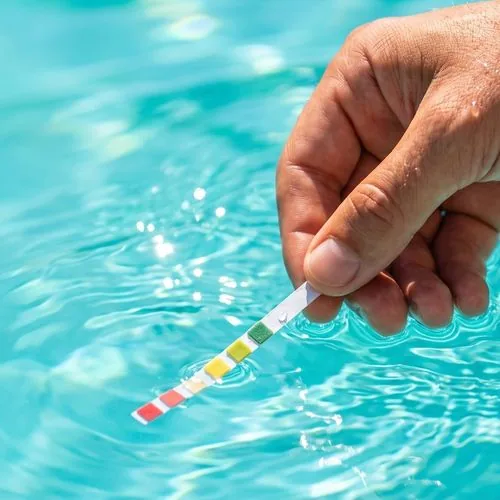 fastShake tester12 tests
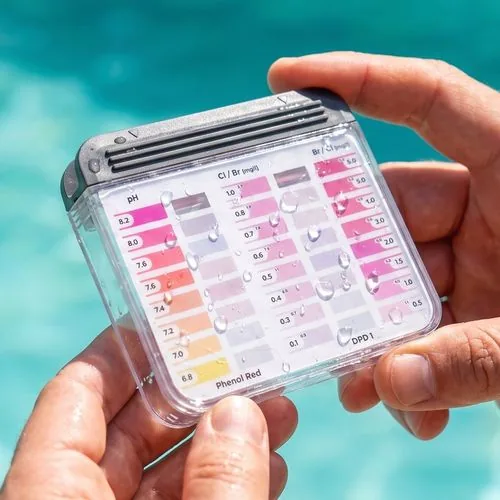 accuratePhotometer13 tests
 very accurateSaltwater testSalinity
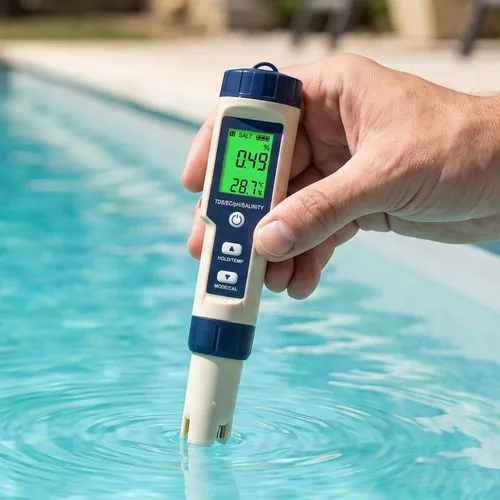 digital
For pools and hot tubs, three values are central: pH, free chlorine and alkalinity, plus cyanuric acid, bromine or salinity depending on the system. Test strips give a quick overview, shake tests with tablets measure more accurately and photometers more precisely still. Test at least 2–3 times a week, and daily in hot weather.
Find your system
The right sets for your pool water
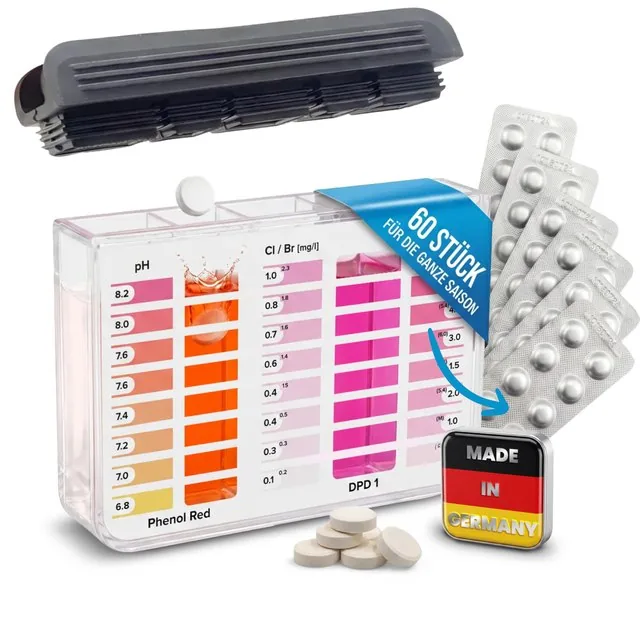

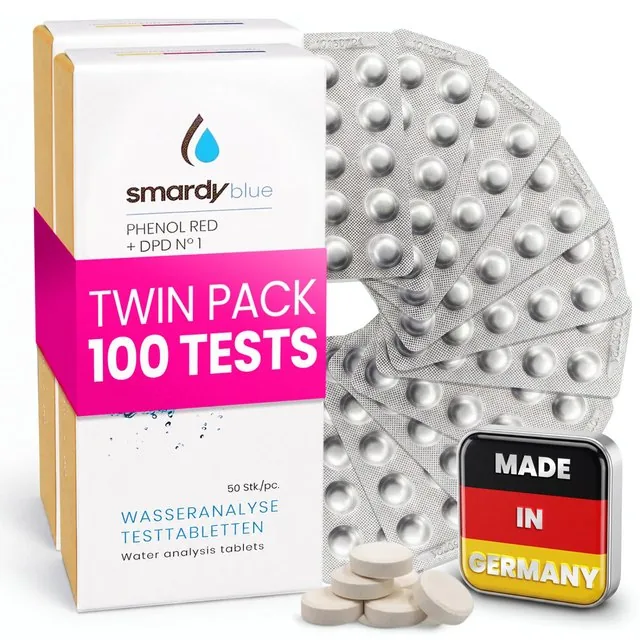
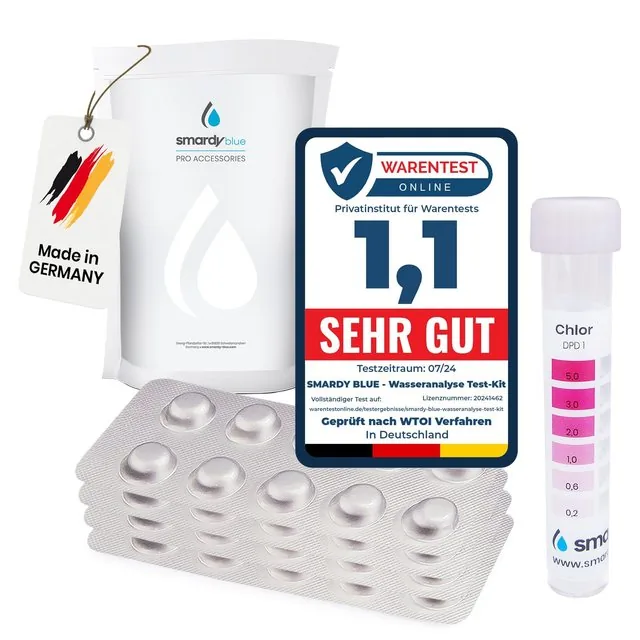
Prices incl. VAT, as of the last update. Amazon prices may have changed; the price on the Amazon product page at the time of purchase applies. As an Amazon Associate we earn from qualifying purchases.
Good to know
The key values at a glance
These values decide whether your pool water stays clear and well-maintained. The ideal range for each:
Test every time
too lowcorrosive, irritates eyes & skin
too highcloudy water, scale, chlorine weaker
TippH minus lowers, pH plus raises
too lowdisinfection too weak, algae possible
too highodour, irritates skin & eyes
Tiptop up or reduce chlorine
too lowdisinfection too weak
too highodour, irritates
Tiptop up or reduce bromine
Water balance
too lowpH swings a lot
too highcloudiness, pH hard to lower
Tipalkalinity plus or pH minus
too lowchlorine burns off fast
too highchlorine lock, no longer works
Tipstabiliser or replace water
too lowcorrosive, foams
too highscale, cloudy water
Tiphardness plus or descaler
When needed
too lowharmless, no lower limit
too highchlorine odour & eye irritation
Tipcarry out shock chlorination
too lowsalt cell makes too little chlorine
too highsalty, promotes corrosion
Tipadd salt or replace some water
Guide
Understand water, test it right
Measure, understand and maintain – specifically for pools and hot tubs.

Pure water — not just in the pool
From reverse osmosis to water testing: water expertise from a single source.
To smardy blueQuick answers
Common questions
In pool water, three values are central: the pH value, free chlorine and alkalinity. The pH value determines how well the chlorine works, free chlorine disinfects the water and alkalinity stabilizes the pH. Depending on the system, cyanuric acid, bromine or salinity are added.
In the pool, a pH value between 7,0 and 7,4 is considered ideal. In this range the chlorine works well and the water stays balanced. Too low a pH value irritates the eyes and skin and attacks materials, while too high a value weakens disinfection and promotes limescale and cloudiness.
The important value is free chlorine: in a normal pool, 0,3 to 0,6 mg/l is ideal, in a hot tub a little more. Too little chlorine weakens disinfection and lets algae grow, too much irritates skin and eyes and smells strong. Measure regularly, especially in heat and heavy use, and top up the dose accordingly.
Alkalinity, also called total alkalinity or TA, is the acid buffering capacity of your pool water. It keeps the pH value stable and prevents it from fluctuating sharply with every addition. The ideal is 80 to 120 mg/l. If the alkalinity is too low, the pH value jumps; if it's too high, it becomes sluggish.
You should test pool water at least two to three times a week, and even daily in hot weather, with lots of swimmers or after heavy rain. The pH value and free chlorine change the fastest and are therefore the main focus. Regular measurements help you spot deviations early.
For a quick overview, test strips are enough – they show the pH value and chlorine in seconds. Shake tests with tablets measure more accurately, and photometers work very precisely. For saltwater pools, there are also digital salt testers. Which method suits you depends on how precisely and how often you want to check your pool values.
Help or advice — feel free to get in touch
Phone: 0800 8727 739
Real people no hold queue — we’re here for you personally.
Mon–Fri 9:00–15:00 · free of charge
Email: info@smardy-blue.com
Drop us a line — we usually reply to every message personally within 24 hours.
Contact us
Still have a question? Through our contact form you’ll quickly find the right answer.