

Home › Digital meters › pH meter
Category
Digital pH meter: measure pH in seconds
Measure pH, TDS and salinity digitally — fast and without consumables.
Set the device to the target value beforehand using calibration solution.
Hold the electrode in the water and stir briefly.
Wait until the displayed value holds steady.
Read the digital value directly.
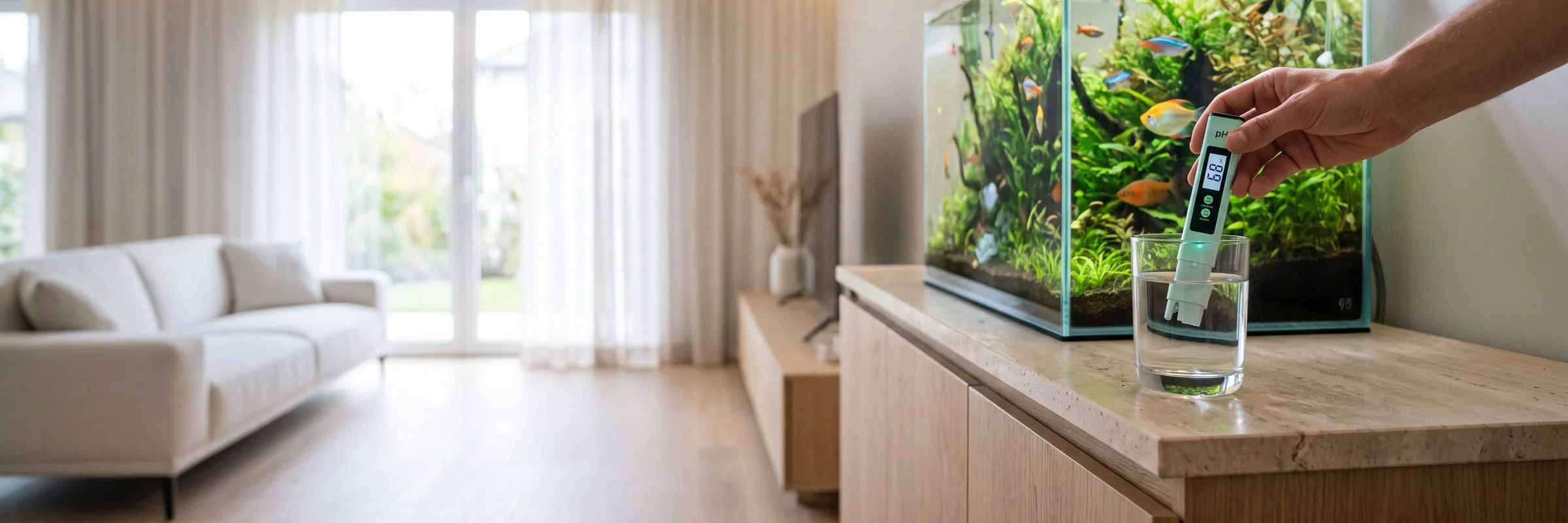
A digital pH meter measures the pH via an electrode that you hold in the water sample; after a few seconds, the display shows the value, with no colour comparison. Calibrate it regularly with buffer solutions, usually pH 7 and pH 4. Keep the electrode moist in storage solution, not in pure water, and rinse it after every measurement.
Good to know
What you measure digitally
The key values a digital meter gives you — and what they point to.
Key values
too lowacidic — attacks materials
too highalkaline — scale, less effect
Tipset the target to suit the use
pH level of water, simply explainedAquarium pH meter: digital pH and conductivity readings

Pure water — not just in the pool
From reverse osmosis to water testing: water expertise from a single source.
To smardy blueQuick answers
Common questions
A digital pH measuring device determines the value via an electrode that you hold in the water sample. After a few seconds, the display shows the exact pH value, with no colour comparison at all. This is particularly handy if you want to check the pH value frequently and precisely, for example in the pool or aquarium.
The pH value determines how aggressive the water is and how well disinfection and nutrient uptake work. In the pool, chlorine only works optimally at the right pH, and in the aquarium it affects how well fish and plants thrive. A stable pH value in the right range is therefore the foundation for clear, balanced water.
Yes, pH measuring devices need to be calibrated regularly with a calibration solution so that the reading stays accurate. Buffer solutions with pH 7 and pH 4 are usually used. How often depends on how you use it – with frequent use, more like weekly. A well-calibrated electrode is the basis for reliable pH readings.
The electrode must not dry out. Keep it moist in the storage solution provided, never in pure water. Rinse it gently after every measurement and don't touch the glass membrane. This keeps the electrode sensitive and delivers accurate values for a long time, instead of becoming sluggish or inaccurate over time.
That depends on the use: in the pool, 7,0 to 7,4 is optimal; in drinking water, 6,5 to 9,5 is permissible; in the aquarium, the ideal value depends on the species and is often between 6,5 and 7,5. Besides the target value, what matters above all is a stable pH without strong fluctuations.
A digital measuring device delivers exact numerical values in seconds and is worthwhile if you need the pH value often or very precisely. Test strips are cheaper, need no calibration and are enough for a quick overview. Anyone who actively manages the pH, for example in an aquarium, benefits from the accuracy of the digital device.
Help or advice — feel free to get in touch
Phone: 0800 8727 739
Real people no hold queue — we’re here for you personally.
Mon–Fri 9:00–15:00 · free of charge
Email: info@smardy-blue.com
Drop us a line — we usually reply to every message personally within 24 hours.
Contact us
Still have a question? Through our contact form you’ll quickly find the right answer.