

Home › Aquarium & pond › Digital meters
Method
Aquarium pH meter: digital pH and conductivity readings
pH and conductivity digitally at a glance — fast, reusable and with no consumables.
Set the pH meter with calibration solution before use.
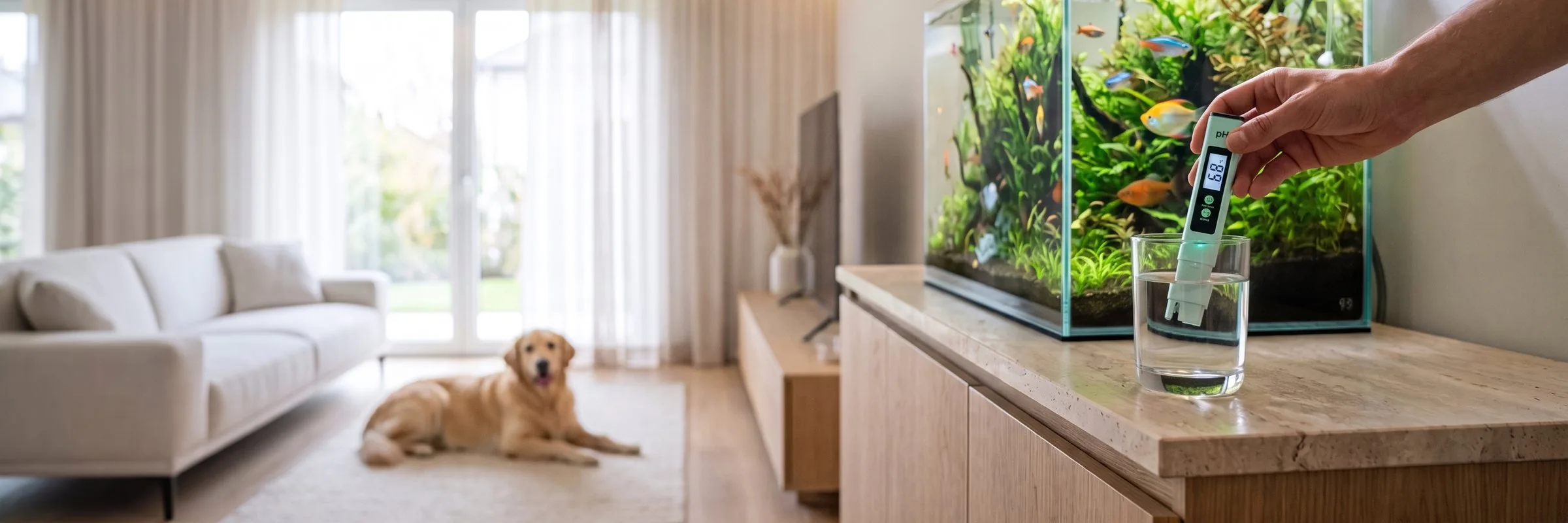
Hold the electrode in the tank water until the value no longer changes.
Read pH or conductivity right off the display.
Rinse the probe; store the pH electrode moist (don't let it dry out).
In the aquarium, digital meters measure the pH value, conductivity or TDS and often the temperature, showing a number in seconds without colour comparison. Calibrate pH meters regularly with buffer solution and keep the electrode moist. Nitrite, ammonium and KH are not detected digitally, so you test those with a drop test.
Measure digitally
What you measure digitally
In the aquarium, digital meters mainly provide two values quickly and reusably: the pH value and the conductivity (µS/cm or TDS). For the nitrogen-related values the drop test remains the method of choice.
Acidity/alkalinity — species-specific depending on stocking, often 6.5 – 7.5.
Sum of dissolved salts/minerals — important for many fish and plant species.
Affects pH, oxygen and the animals' metabolism.
Good to know
Digital meters do not capture ammonium/ammonia, nitrite and KH — exactly the values that are decisive during cycling and for stable conditions in the tank. That's what the drop test is made for.
pH level of water, simply explainedCycling an aquarium: from setup to the first fishAquarium drop test: precise single valuesDigital pH meter: measure pH in secondsTDS meter: measure dissolved solids digitally
Overview
Benefits & limits
- Benefits: second-fast pH/conductivity checks, reusable, no consumption.
- Limits: no nitrogen values (nitrite, ammonium) and no KH/GH — use a drop test or test strips for those. Calibration required.

Find the right tests for your tank
Drop test, test strips or digital — the product finder guides you to the right method in a few steps.
To the product finderQuick answers
Common questions
In the aquarium, digital measuring devices are especially suited to the pH value, conductivity and the TDS value, as well as temperature. They show precise numbers in seconds and without colour comparison. For nitrogen values such as nitrite and ammonium, however, drop tests remain the more reliable choice, since digital devices do not detect them.
The conductivity shows how mineral-rich your aquarium water is. For many fish and plants, especially shrimp and species that love soft water, a certain range is important. A digital measuring device shows the conductivity instantly, so that when preparing your water you can specifically mix softer or harder water and create stable conditions.
You should calibrate pH measuring devices regularly with buffer solution so they stay accurate. Conductivity and TDS pens are usually factory-calibrated, but benefit from an occasional check with a reference solution. Keep the electrodes moist, rinse them after every measurement and store the devices dry – that way your aquarium values stay reliable in the long term.
The two complement each other: digital devices are ideal for pH, conductivity and TDS, which they display within seconds and accurately. For the critical nitrogen values ammonium and nitrite, drop tests are the reliable choice. Many aquarists use a digital pH/conductivity device together with drop tests to cover all the important values.
You can check the pH value and conductivity weekly in an established tank, and more often when conditioning the water. Because digital measurements are quick, they're easy to fit into your routine. What matters is measuring regularly at the same time of day, since the pH value shifts slightly over the course of the day due to the plants.
A digital device is particularly worthwhile for demanding tanks, soft-water-loving species or when you want to control the pH value and conductivity precisely. It provides exact figures without colour comparison. For simple community aquariums with occasional checks, test strips and a drop test for the nitrogen values are usually sufficient.
Help or advice — feel free to get in touch
Phone: 0800 8727 739
Real people no hold queue — we’re here for you personally.
Mon–Fri 9:00–15:00 · free of charge
Email: info@smardy-blue.com
Drop us a line — we usually reply to every message personally within 24 hours.
Contact us
Still have a question? Through our contact form you’ll quickly find the right answer.