

Home › Drinking water & home › Test strips
Category
Drinking water test strips: check your tap water
Check your tap water in seconds — simply with test strips.
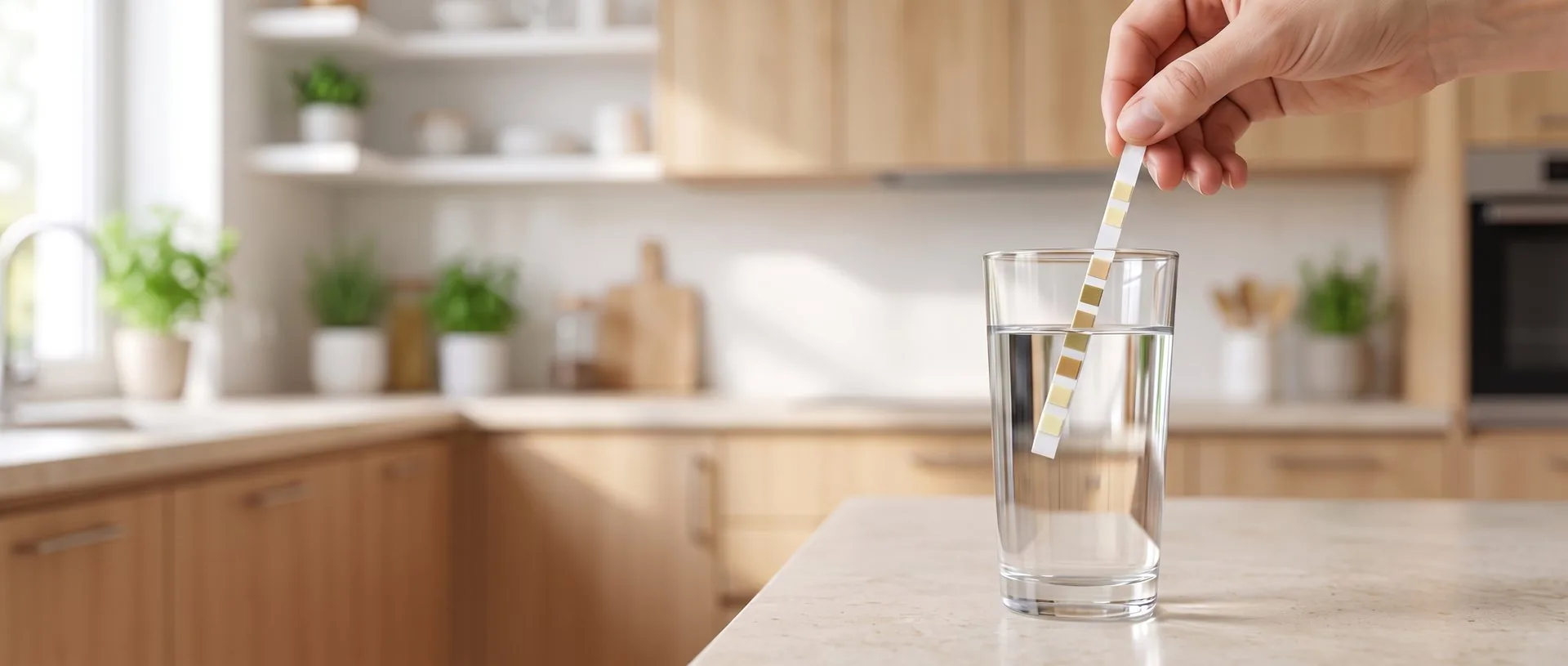
Briefly dip the strip in tap water, wetting all pads.
Pull it out and let the water drip off, don't shake it.
Wait about 60 seconds until the colours settle.
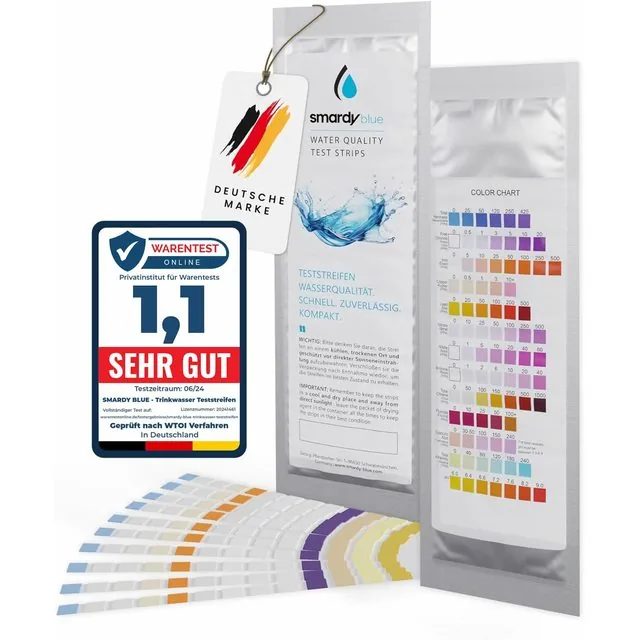
Compare the colours with the scale on the tin.
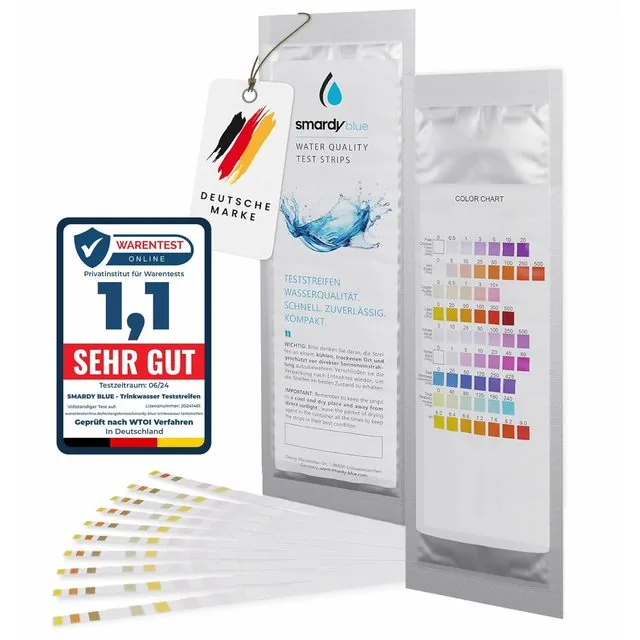
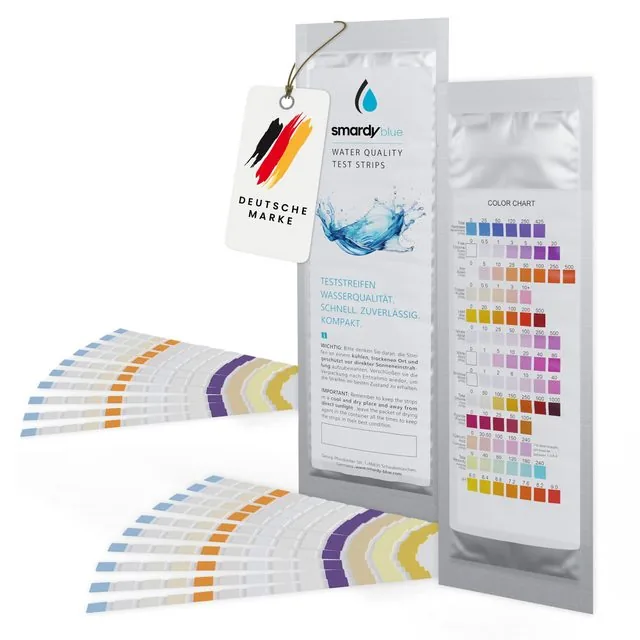
Drinking water test strips measure water hardness, nitrate and pH, and depending on the strip also nitrite, chlorine, lead or copper – up to 13 values per strip. Let the water run briefly, dip the strip, let it drain and compare the colours after about 60 seconds. For legally reliable values, you need an accredited lab.
How to test
Test your tap water
Whether test strips, a digital meter or a lab test — find the method that fits your tap water.
Prices are a non-binding guide and may vary; the price shown on Amazon at the time of purchase always applies.
Good to know
These values matter
The key values for clean, great-tasting tap water at a glance.
Test every time
too lowtastes flat, slightly corrosive
too highlimescale in kettle, pipes & appliances
Tipfilter or softener for hard water
too lowacidic, can dissolve metals
too highsoapy taste, limescale spots
Tipusually managed by the utility
Limits
too lowharmless, no lower limit
too highabove 50 mg/l — above the limit
Tipwith your own well, test regularly
too lowharmless, no lower limit
too highsign of bacteria, max. 0.5 mg/l
Tiplet the water run, test again
When needed
too lowharmless, no lower limit
too highchlorine taste & smell
Tiplet the water sit briefly
too lowharmless, no lower limit
too highabove 0,01 mg/l — above the limit
Tiplet stagnant water run off in the morning
Drinking water advisor: understand your test resultsTap water quality: what comes out of your tapHow to test drinking water: values and limitsWater for your coffee machine: the right hardness

Pure water — not just in the pool
From reverse osmosis to water testing: water expertise from a single source.
To smardy blueQuick answers
Common questions
Drinking water test strips typically measure water hardness, nitrate content and the pH value, and many also cover nitrite, chlorine as well as lead or copper. Multi test strips show several of these values at once. This gives you an overview in seconds of whether your tap or well water stays within the usual limits or shows anything unusual.
First let the water run for a moment, so that you test fresh tap water and not standing water. Hold the strip in it briefly, shake it off and compare the colours with the scale after the specified time, in daylight. Close the container again immediately afterwards so the remaining strips stay dry.
Test strips give you a quick, reliable indication of whether your values are within the usual range. However, they are no substitute for a laboratory analysis, since comparing colours by eye only gives rough gradations. For a first impression and regular monitoring they are enough; for legally reliable values you need an accredited laboratory test.
Yes, multi test strips are well suited to well and spring water, because they show typical values such as hardness, nitrate, nitrite and pH at the same time. This lets you quickly spot unusual values. For official approval as drinking water, or if you have a specific suspicion of contaminants, a laboratory analysis is also required.
What matters most is nitrate, nitrite as well as lead and copper from old pipes, plus bacteria if you have your own well. For everyday life, water hardness is also of interest, because it determines limescale in appliances. A multi-strip covers many of these values and quickly shows where a closer check is worthwhile.
To assess the current state, a single measurement is enough to begin with. After that, it is worth testing again whenever something changes – after moving house, if the taste changes, with new pipes or if you have your own well. Regular short checks with test strips help you spot changes early, before they become a problem.
Help or advice — feel free to get in touch
Phone: 0800 8727 739
Real people no hold queue — we’re here for you personally.
Mon–Fri 9:00–15:00 · free of charge
Email: info@smardy-blue.com
Drop us a line — we usually reply to every message personally within 24 hours.
Contact us
Still have a question? Through our contact form you’ll quickly find the right answer.