

Home › Guide › Pool chlorine level
Pool chlorine level
Pool chlorine levels aren’t set by law for private pools. As a guide, you can go by 0.3 to 0.6 mg/l free chlorine from the German standard DIN 19643 for public pools. The Bavarian State Office for the Environment (LfU) gives around 0.3 mg/l for private pools. Combined chlorine should be no more than 0.2 mg/l.
Good to know
The key values at a glance
The key facts about your pool chlorine level in four points.
- Free chlorine: guide value 0.3 to 0.6 mg/l
- Combined chlorine: no more than 0.2 mg/l
- pH level: 7.0 to 7.4 – adjust it first, then add chlorine
- Measuring: at least once a week, ideally two to three times
What the chlorine level tells you about your pool water
Chlorine is the most widely used product for disinfecting pool water. It gets rid of bacteria and algae as long as enough of it is active in the water. That’s exactly what the chlorine level shows: how much chlorine is currently at work, measured in milligrams per litre (mg/l).
If there’s too little chlorine in the water, it can turn cloudy and green. If there’s too much, skin and eyes can become irritated, as the German Environment Agency (UBA) points out. That’s why measuring instead of guessing is the most important step.
Values at a glance
What chlorine level is right for your pool?
These values give you a guide. Some chlorine products state higher values for private pools – in that case, your product’s instructions apply.
Free chlorine
- Ideal value
- 0,3–0,6 mg/l
- below 0.3 mg/l: too little
- 0.3–0.6 mg/l: guide range
- higher: only if your chlorine product’s instructions say so
Guide value from the German standard DIN 19643 for public pools. For private pools, the Bavarian State Office for the Environment gives around 0.3 mg/l.
- How to test this value
- With DPD1 tablets in a shake test or photometer, or with test strips.
Combined chlorine
- Ideal value
- max. 0.2 mg/l
- up to 0.2 mg/l: fine
- above 0.2 mg/l: smell and irritation possible
Precautionary value from DIN 19643. Combined chlorine hardly works any more and causes the typical chlorine smell.
- How to test this value
- Measure total chlorine (DPD3) and subtract the free chlorine (DPD1).
Free chlorine in a hot tub
- Ideal value
- 0.7–1.0 mg/l
- below 0.7 mg/l: too little
- 0.7–1.0 mg/l: guide range
Guide value from DIN 19643 for public spa pools. Your hot tub’s instructions take priority.
- How to test this value
- As in the pool, with DPD1 tablets or test strips.
pH level
- Ideal value
- 7,0–7,4
- below 7.0: too low
- 7.0–7.4: correct
- above 7.4: chlorine works less well
Recommended by the Bavarian State Office for the Environment. If the pH level is off, even more chlorine won’t help much.
- How to test this value
- With phenol red tablets or test strips, right before measuring chlorine.
Free, combined and total chlorine – the difference
Free chlorine is the part that does the work in the water. When you add chlorine to the water, this produces hypochlorous acid, among other things, which disinfects. You measure this active part with DPD1 tablets.
Combined chlorine forms when chlorine reacts with substances that swimmers bring into the water, such as sweat, skin flakes or urea. These compounds are called chloramines. They barely disinfect any more, have a pungent smell and irritate the eyes.
Total chlorine is both together. You measure it with DPD3 tablets for photometers or with a test strip that has a pad for total chlorine. Subtract the free chlorine from it and what’s left is the combined chlorine. Total chlorine can never be lower than free chlorine – if your test shows that, the measurement is wrong.
How to read the colour scale on a chlorine test
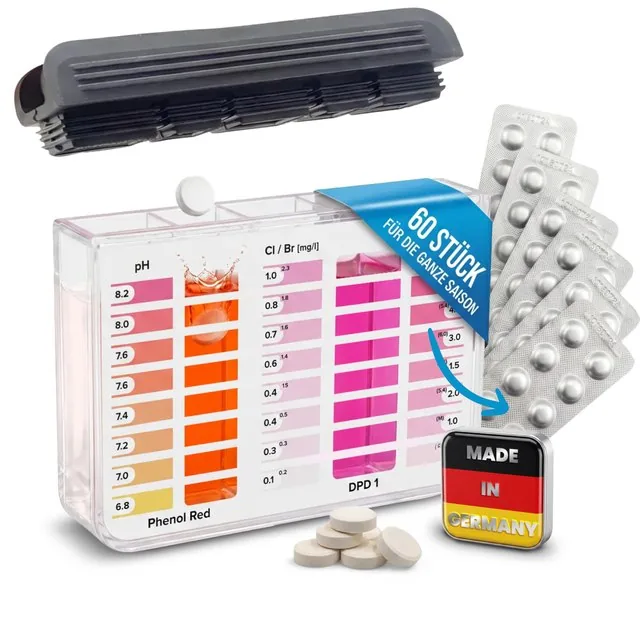
In a tablet test, the dye DPD turns the water pink to red. The more free chlorine there is in the water, the stronger the colour. Here’s how to read it correctly:
- After about 60 seconds, compare the colour in daylight against a light background.
- If the colour falls between two steps on the scale, so does the value.
- The scale of the smardy blue Pool Tester covers free chlorine from 0.1 to 6.0 mg/l.
- If the sample stays colourless, there’s no measurable free chlorine – or so much that the colour bleaches out. The next section explains how to tell the difference.
- With test strips, compare each pad with the scale on the container exactly after the stated waiting time.
Test shows 0 even though you’ve just added chlorine?
A very high chlorine level can bleach out the dye. The sample briefly turns pink and then pale again, and the test shows too little or even 0.
Check this with a diluted sample: fill the measuring chamber halfway with pool water and up to the mark with distilled water. Multiply the reading by 2. For very high levels, mix 1 part pool water with 9 parts distilled water and multiply the result by 10. Never measure the pH level diluted.
Chlorine too low: causes and what helps
If free chlorine is below the guide value, these are the most common reasons:
- Sun: Its UV light breaks down chlorine. A cover keeps the light out when nobody is swimming. That way the chlorine stays effective for longer, says the German Environment Agency.
- Lots of swimmers and hot weather: Every swimmer brings substances into the water that use up chlorine.
- Rain, leaves and insects: They also eat into the chlorine. Skimming with a net and covering the pool help.
- pH level too high: The chlorine can still be measured, but it works less well. Adjust the pH level first.
- What helps: Check the pH level, top up chlorine as directed on the label and measure again after a few hours. With algae and green water, shock chlorination helps. The Bavarian State Office for the Environment gives around 1 mg/l overnight for this.
Chlorine too high: in brief
If the chlorine level is far too high, stop adding chlorine, remove the cover so that sunlight can break down the chlorine, let the filter system run and measure again. With very high levels, a partial water change helps.
You’ll find all the steps in detail in the guide ‘Chlorine in the pool’. Important if you drain water: according to the German Environment Agency, treated pool water belongs in the sewer, not in the garden. If in doubt, ask your local authority.
Cyanuric acid: protection with a catch
Chlorine products for outdoor use often contain cyanuric acid. This stabiliser protects the chlorine from being broken down quickly by sunlight.
With every dose, more cyanuric acid builds up in the water, and too much of it slows down the chlorine’s effect. The German Environment Agency advises checking whether your chlorine contains cyanuric acid and names milky cloudiness as a possible sign of too much. According to the agency, it can be lowered with fresh water. The Bavarian State Office for the Environment recommends replacing part of the water every spring.
Pool maintenance tips for clear water all seasonWinterising your pool: step by step
Why does the pool smell of chlorine?
The typical indoor pool smell doesn’t come from free chlorine but from combined chlorine. Chloramines form when chlorine reacts with sweat, urea or skin flakes. So a strong smell doesn’t mean there’s too much chlorine in the water. Often there’s actually too little free chlorine for the amount of dirt.
Measure free and total chlorine before you add more. Showering before swimming helps, because less urea then gets into the water.
How to measure the chlorine level correctly
- 1
Let the pump run for a while beforehand and rinse the tester with pool water – without washing-up liquid.
- 2
Don’t take the sample right at the surface or directly in front of an inlet nozzle.
- 3
Fill the measuring chamber up to the mark – with the smardy blue Pool Tester, that’s 10 ml.
- 4
Drop a DPD1 tablet straight from the blister pack into the chamber without touching it with your fingers.
- 5
Close the tester and shake it until the tablet has completely dissolved.
- 6
Read the value off the colour scale after about 60 seconds.
- 7
Measure the pH level at the same time. Only then can you interpret the chlorine level properly.
What to measure pool chlorine with
There are three common ways to measure chlorine:
- Shake test with DPD1 tablets: Measures free chlorine right at the poolside, together with the pH level.
- Test strips: Depending on the strip, they show free and total chlorine at a glance. This also lets you estimate the combined chlorine.
- Photometer: Measures free chlorine (DPD1) and total chlorine (DPD3) electronically and shows the value as a number. Photometer tablets are crushed and are not suitable for shake testers.
In short
There’s no fixed chlorine level for private pools. Go by 0.3 to 0.6 mg/l free chlorine and no more than 0.2 mg/l combined chlorine, at a pH level of 7.0 to 7.4. Measure at least once a week, ideally two to three times. If the pool smells of chlorine, combined chlorine is usually behind it – not too much free chlorine.
Sources:
- City of Munich: information sheet ‘Betrieb von Schwimmbädern – Anforderungen an das Rein- und Beckenwasser’ (operating swimming pools – requirements for treated water and pool water) based on DIN 19643-1 (as of 24 April 2026). The German standard DIN 19643 applies to public pools; for private pools it serves only as a guide.
- Bavarian State Office for the Environment (LfU): information sheet ‘Pool, nasses Vergnügen mit Verantwortung’ (pools: fun in the water, with responsibility) – private swimming pools up to 100 m³ (2023), section 2.3
- German Environment Agency (UBA): ‘Fragen und Antworten zum Thema Swimmingpool’ (questions and answers on swimming pools), as of 11 June 2024
- German Environment Agency (UBA): ‘Schwimmbeckenhygiene und Entsorgung von Poolwasser’ (keeping pool water clean and disposing of pool water), as of 1 October 2026
- German Environment Agency (UBA): ‘Wasserqualität der Schwimm- und Badebecken’ (water quality in swimming and bathing pools), as of 13 November 2013
- smardy blue Pool Tester Set PT100: use and scale ranges according to the product description on Amazon
Last updated:
Products
Find the right test for you
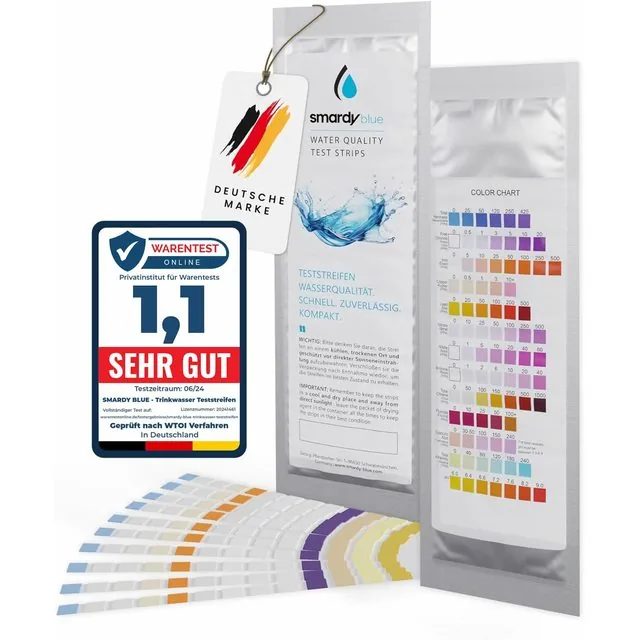 Test stripssmardy blue 13-in-1 Test stripsFree and total chlorine on one strip, plus pH level and cyanuric acid.pH levelTotal hardnessAlkalinityfree chlorineTotal chlorineNitrateNitriteLeadBromineCyanuric acidFluorideCopperIron10 test stripsCheck price*To Amazon
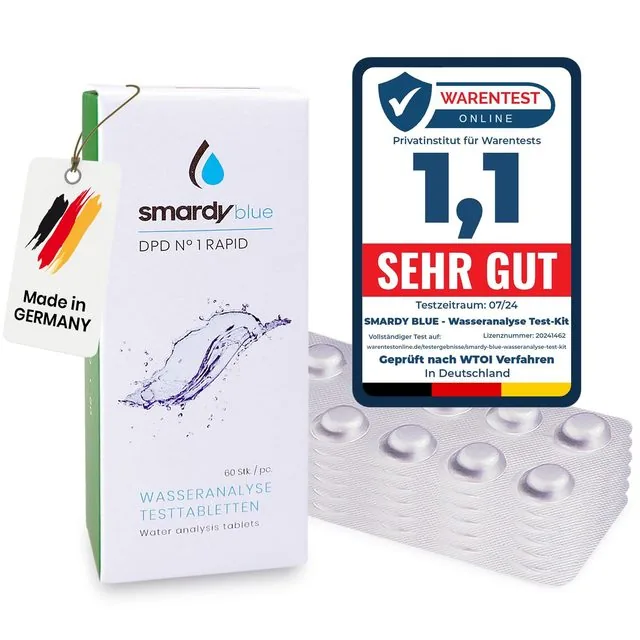 Tablets for shake testerssmardy blue DPD1 Refill TabletsReplacement tablets for free chlorine in shake testers.free chlorine60 tabletsCheck price*To Amazon
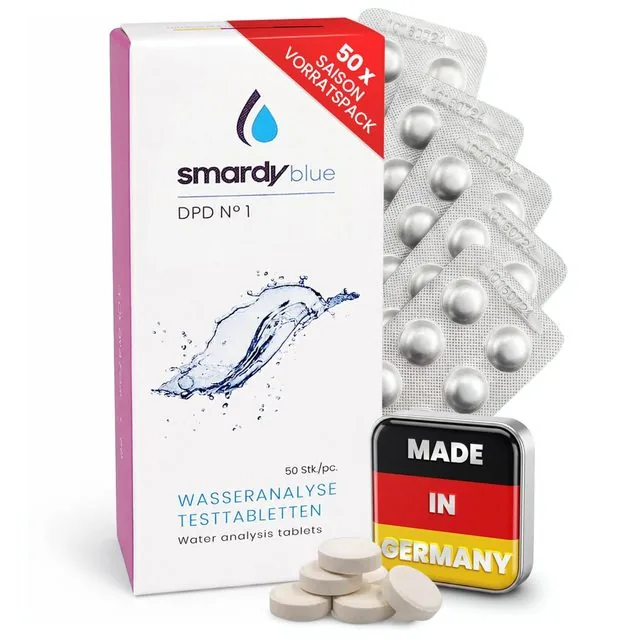 Photometer tablets for electronic pool testerssmardy blue DPD1 Photometer TabletsFree chlorine as a number, for photometers, not for shake testers.free chlorine50 tabletsCheck price*To Amazon
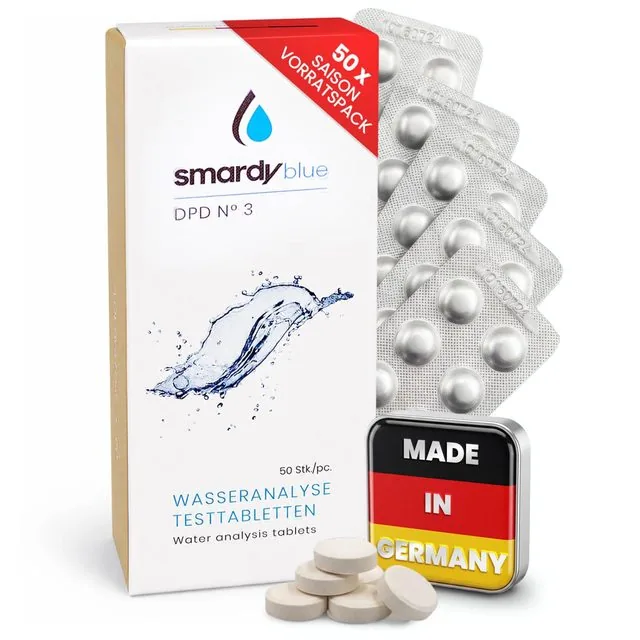 Photometer tablets for electronic pool testerssmardy blue DPD3 Photometer TabletsTotal chlorine – together with DPD1 you can see the combined chlorine.Total chlorine50 tabletsCheck price*To Amazon
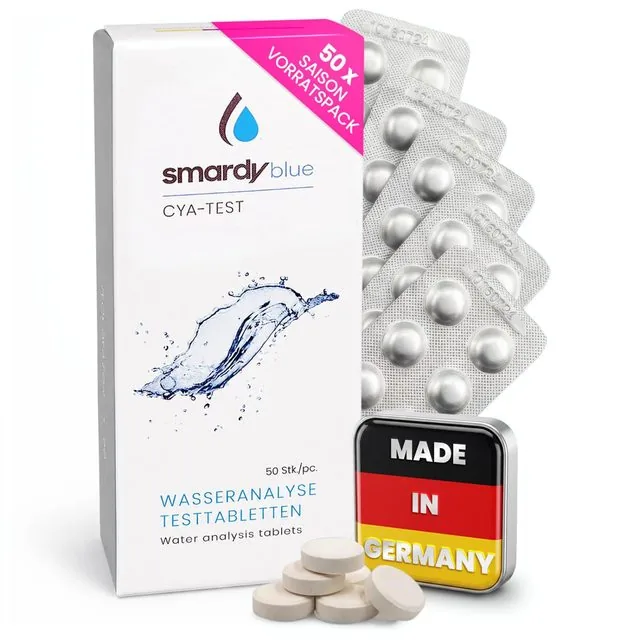 Photometer tablets for electronic pool testerssmardy blue CyA Photometer TabletsShows whether too much stabiliser has built up.Cyanuric acid50 tabletsCheck price*To Amazon
* You can see the current price directly on Amazon – it can change at any time; the price shown at the time of purchase applies.

Pure water — not just in the pool
From reverse osmosis to water testing: water expertise from a single source.
To smardy blueQuick answers
Common questions
What chlorine level is right for your pool?
There’s no legal value for private pools. The guide is 0.3 to 0.6 mg/l free chlorine, taken from the German standard DIN 19643 for public pools. The Bavarian State Office for the Environment (LfU) gives around 0.3 mg/l for private pools. If your chlorine product states different values, follow its instructions.
What’s the difference between free and combined chlorine?
Free chlorine is the active part that disinfects. Combined chlorine has already reacted with dirt, hardly works any more and smells. You work it out as total chlorine minus free chlorine. It should be no more than 0.2 mg/l.
How do I read the colour scale on a chlorine test?
DPD turns the sample pink to red: the stronger the colour, the more free chlorine. After about 60 seconds, compare it with the scale in daylight against a light background. If the colour falls between two steps, so does the value.
Why does my pool smell of chlorine?
The smell comes from combined chlorine, i.e. chloramines. They form when chlorine reacts with sweat, urea or skin flakes. Often there’s actually too little free chlorine in the water. Measure free and total chlorine before you add more.
What should I do if the chlorine level is too low?
First check the pH level and adjust it to between 7.0 and 7.4. Then add chlorine as directed on the label and measure again after a few hours. Cover the pool when nobody is swimming. That way sunlight breaks down the chlorine more slowly.
What should I do if the chlorine level is too high?
Stop adding chlorine, remove the cover, let the filter system run and measure again. With very high levels, a partial water change helps. Check beforehand with a diluted sample whether the value really is that high.
What chlorine level applies in a hot tub?
The German standard DIN 19643 gives 0.7 to 1.0 mg/l free chlorine for public spa pools. For your hot tub at home, that’s a guide. The manufacturer’s instructions take priority.
How often should I test the chlorine level?
At least once a week, ideally two to three times – that’s what the instructions for the smardy blue Pool Tester recommend. After hot weather, rain or lots of swimmers, take extra measurements, always together with the pH level.
Help or advice — feel free to get in touch
Phone: 0800 8727 739
Real people no hold queue — we’re here for you personally.
Mon–Fri 9:00–15:00 · free of charge
Email: info@smardy-blue.com
Drop us a line — we usually reply to every message personally within 24 hours.
Contact us
Still have a question? Through our contact form you’ll quickly find the right answer.