

Good to know
The key values at a glance
The key facts about your pool pH level in four points.
- Guide value: pH 7.0 to 7.4
- Measuring: at least once a week, ideally two to three times
- Order: adjust the pH level first, then dose chlorine
- Correcting: always in small steps, then measure again
Why the pH level in your pool is so important
The pH level shows whether water is acidic, neutral or basic. The scale runs from 0 to 14; at 7, water is neutral. For your pool, what counts is a narrow range just above that: 7.0 to 7.4.
How well your pool care products work depends on this value. The Bavarian State Office for the Environment (LfU) gives 7.0 to 7.4 as the range in which the usual disinfectants and flocculants are most effective. If the pH level rises, chlorine becomes less effective. You then add more and still end up with poorer water quality.
Don’t be fooled by the small numbers: the pH scale is logarithmic. Each whole step means a tenfold change. That’s why it’s worth paying attention to every tenth of a pH unit.
Values at a glance
What pH level is right for your pool?
There’s no legal limit for private pools. These values give you a guide – the instructions for your pool care products always take priority.
pH level
- Ideal value
- 7,0–7,4
- below 7.0: too low
- 7.0–7.4: correct
- above 7.4: too high
Recommended by the Bavarian State Office for the Environment for private pools. In this range, chlorine and flocculants are most effective.
- How to test this value
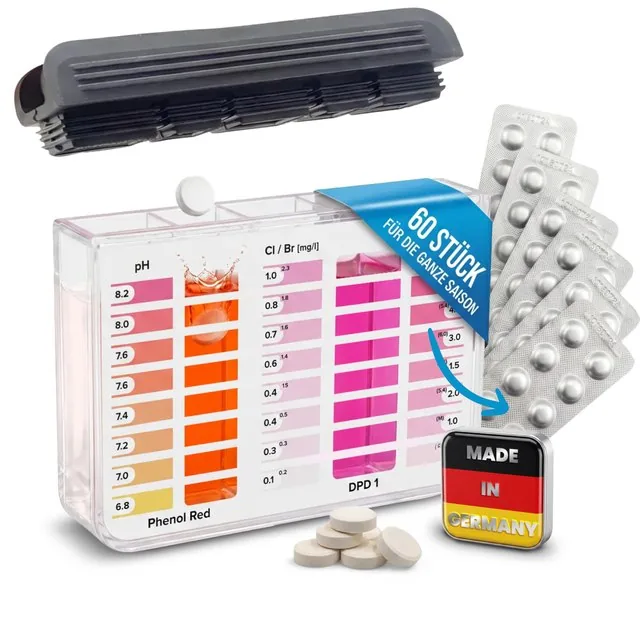
- With phenol red tablets in a shake test or photometer, or with test strips.
Free chlorine
- Ideal value
- 0,3–0,6 mg/l
- below 0.3 mg/l: too little
- 0.3–0.6 mg/l: guide range
- higher: only if your chlorine product’s instructions say so
Guide value from the German standard DIN 19643 for public pools. How well chlorine works depends directly on the pH level.
- How to test this value
- With DPD1 tablets or test strips, ideally together with the pH level.
pH level too high: causes and effects
Above 7.4, the pH level is too high – the more common case in pools. Chlorine then works less well, limescale builds up more easily in hard water, and eyes and skin can become irritated. Typical causes:
- Fresh filling water: Under the German Drinking Water Ordinance, drinking water may have a pH level of 6.5 to 9.5. That’s why the value is often outside the pool range after filling.
- Moving water: A waterfall, a counter-current unit or bubble jets drive carbon dioxide out of the water. This makes the pH level rise.
- Salt water chlorinators: Systems that produce chlorine from salt usually make the pH level rise.
- Algae: Growing algae use up carbon dioxide. This also raises the pH level.
pH level too low: causes and effects
Below 7.0, the pH level is too low. Metal parts such as ladders, fittings or heat exchangers can then be attacked, and here too, eyes and skin can be sensitive to it. Typical causes:
- Rain: According to the German Environment Agency (UBA), rainwater has a relatively low pH level and hardly any hardness. After heavy rain, the value often drops.
- Too much pH minus: If you add too much at once, you’ll quickly end up below 7.0.
- Too little buffer: With soft water or low alkalinity, the pH level reacts strongly to every addition.
How to measure the pH level correctly
- 1
Let the pump run for a while beforehand so that the water mixes.
- 2
Rinse the tester with pool water – without washing-up liquid.
- 3
Don’t take the sample right at the surface or directly in front of an inlet nozzle.
- 4
Fill the measuring chamber up to the mark – with the smardy blue Pool Tester, that’s 10 ml.
- 5
Drop a phenol red tablet straight from the blister pack into the chamber without touching it with your fingers.
- 6
Close the tester and shake it until the tablet has completely dissolved.
- 7
After about 60 seconds, compare the colour with the scale in daylight against a light background.
- 8
Note down the date, the value and what you added. That way you’ll notice early on if the value starts to drift.
Test shows 6.8 or 8.2? Here’s what that means
The colour scale of the smardy blue Pool Tester covers pH levels from 6.8 to 8.2. If the test shows exactly one of these end values, the real value may be even lower or higher. In that case, correct with particular care and measure again after each addition.
Right after shock chlorination, a very high chlorine level can distort the colour. In that case, only measure the pH level again once the chlorine is back in its usual range.
How to lower or raise the pH level – step by step
- 1
Measure first, then act. Never dose by guesswork.
- 2
If the value is too high, use pH minus (pH reducer). If it’s too low, use pH plus (pH increaser).
- 3
Work out the amount for your pool volume as stated on the label. For a round pool, calculate diameter × diameter × 0.785 × water depth in metres. A pool with a diameter of 3.60 m and a water depth of 0.80 m therefore holds just over 8 m³, i.e. more than 8,000 litres.
- 4
Add too little rather than too much – spread it evenly, with the pump running.
- 5
Let the water circulate for a few hours, then measure again.
- 6
Repeat until the value is between 7.0 and 7.4. Only then add chlorine.
- 7
Never mix pool care products with each other, and never add them to the water at the same time.
pH level keeps jumping? Then the buffer is missing
Alkalinity – also called total alkalinity (TA) or acid-neutralising capacity – buffers the pH level. If it is too low, the pH level reacts strongly to every downpour and every addition, and swings back and forth.
So if your pH level fluctuates, measure the alkalinity as well. Adjust it according to the instructions for your test and pool care product before you correct the pH level.
pH level first, then chlorine
Chlorine only works as well as the pH level allows. So always adjust the pH level first and add chlorine afterwards.
If you keep adding more chlorine while the pH level is too high, you won’t solve the problem: the chlorine still works poorly, and the chlorine level rises unnecessarily. The guide on pool chlorine levels tells you which level is right.
Pool chlorine levelPool chlorine too high: measure, lower, dose right
What to measure your pool pH level with
There are four ways. Which one suits you depends on how often and how precisely you want to measure.
- Test strips: Dip, wait, compare the colours – quick and handy for regular checks. The dipping and waiting times are on the container and vary from strip to strip.
- Shake test: A phenol red tablet colours the sample, and you read the value off the tester’s colour scale. The colour shows up more clearly in the sample than on a strip pad.
- Photometer: An electronic device measures the colouring and shows the value as a number. Photometer tablets are crushed and are not suitable for shake testers. You can recognise them by the black lettering on the blister pack; tablets for shake testers have green lettering.
- pH meter: Measures with an electrode and needs to be calibrated regularly with buffer solutions.
In short
In your pool, the pH level should be between 7.0 and 7.4. Measure it at least once a week, ideally two to three times, and always before chlorine. If it’s too high, pH minus helps; if it’s too low, pH plus – as directed on the label, in small steps and with a follow-up measurement. If it keeps fluctuating, check the alkalinity.
Sources:
- Bavarian State Office for the Environment (LfU): information sheet ‘Pool, nasses Vergnügen mit Verantwortung’ (pools: fun in the water, with responsibility) – private swimming pools up to 100 m³ (2023), section 2.3
- German Environment Agency (UBA): ‘Fragen und Antworten zum Thema Swimmingpool’ (questions and answers on swimming pools), as of 11 June 2024
- German Drinking Water Ordinance 2023 (Trinkwasserverordnung), Annex 3, Part I (pH level 6.5 to 9.5)
- City of Munich: information sheet ‘Betrieb von Schwimmbädern – Anforderungen an das Rein- und Beckenwasser’ (operating swimming pools – requirements for treated water and pool water) based on DIN 19643-1 (as of 24 April 2026). The German standard DIN 19643 applies to public pools; for private pools it serves only as a guide.
- smardy blue Pool Tester Set PT100: use and scale ranges according to the product description on Amazon
Last updated:
Products
Find the right test for you
 Test stripssmardy blue 3-in-1 Test stripsThree values with one strip, read after 15 seconds.pH levelAlkalinityActive oxygen50 test stripsCheck price*To Amazon
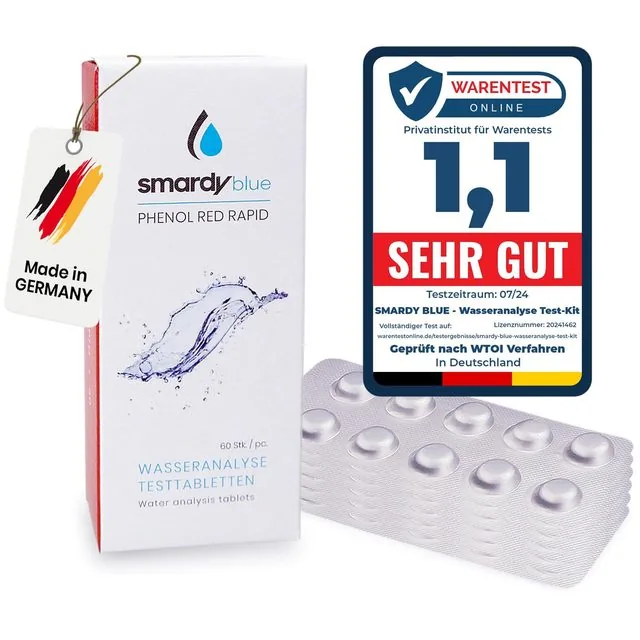 Tablets for shake testerssmardy blue Phenol Red Refill TabletsReplacement tablets for the pH level in shake testers.pH level60 tabletsCheck price*To Amazon
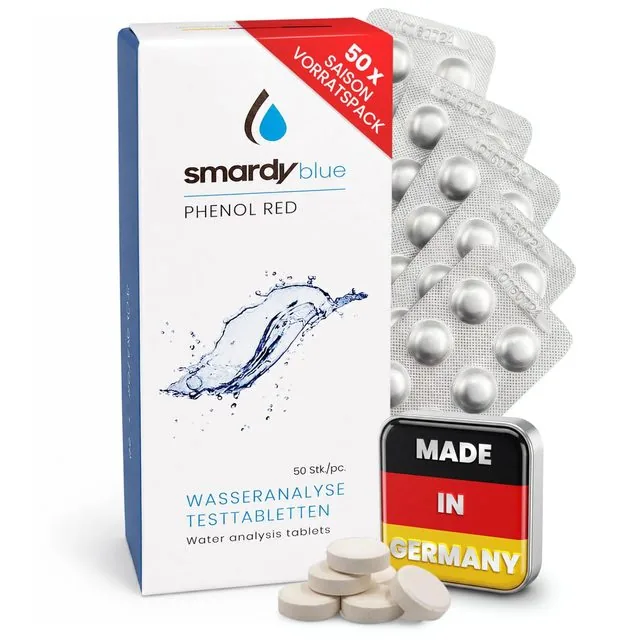 Photometer tablets for electronic pool testerssmardy blue Phenol Red Photometer TabletsFor electronic pool testers and photometers, not for shake testers.pH level50 tabletsCheck price*To Amazon
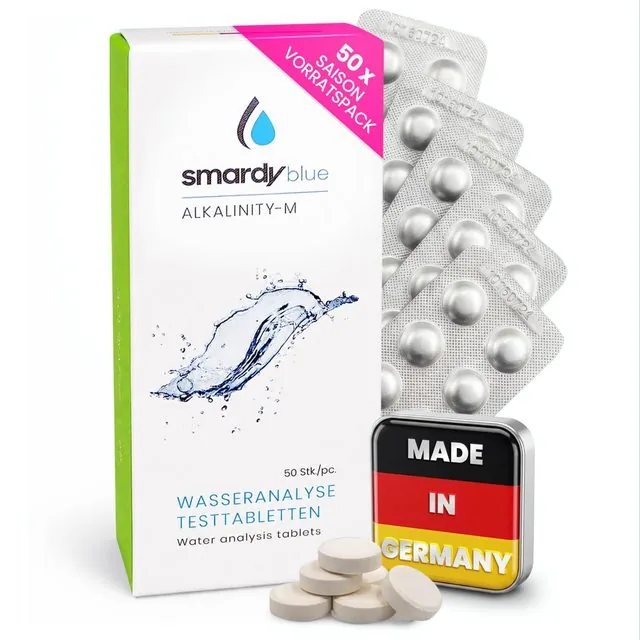 Photometer tablets for electronic pool testerssmardy blue Alka-M Photometer TabletsMeasures the buffer that keeps the pH level stable.alkalinity (acid-neutralising capacity)50 tabletsCheck price*To Amazon
* You can see the current price directly on Amazon – it can change at any time; the price shown at the time of purchase applies.

Pure water — not just in the pool
From reverse osmosis to water testing: water expertise from a single source.
To smardy blueQuick answers
Common questions
Which pH value is ideal in the pool?
Between 7.0 and 7.4. The Bavarian State Office for the Environment (LfU) gives this range for private pools, because chlorine and flocculants are most effective there. If the value is higher, chlorine works less well.
What should I do if my pool pH level is too high?
Add pH minus as directed on the label, in small steps and with the pump running, let the water circulate for a few hours and then measure again. Repeat until the value is between 7.0 and 7.4. If it keeps rising, check the alkalinity and typical causes such as bubble jets or a salt water chlorinator.
What should I do if my pool pH level is too low?
Raise it with pH plus as directed on the label, in small steps, and measure again after a few hours. Common causes are heavy rain or too much pH minus. If the value keeps dropping, the alkalinity is often too low.
Can I swim if the pH level is off?
Small deviations are no cause for concern. But if the value is well off, chlorine works less well and eyes and skin can become irritated. So correct the value first. After adding pH minus or pH plus, stick to the waiting time on the label.
Why does my pool pH level keep rising?
Usually, moving water drives out carbon dioxide – for example through bubble jets, a waterfall or a counter-current unit. A salt water chlorinator, algae or fresh filling water also raise the value. With the right alkalinity, the pH level stays more stable.
How often should I test my pool pH level?
At least once a week, ideally two to three times. That’s also what the instructions for the smardy blue Pool Tester recommend. After heavy rain, in hot weather or when lots of people are swimming, take extra measurements.
Why do some sources give different pH levels?
Because they apply to other types of pool. The German standard DIN 19643 covers public pools: there, depending on the flocculant, the pH level is 6.5 to 7.2 or 6.5 to 7.5, and it is measured continuously. For private pools, the Bavarian State Office for the Environment gives 7.0 to 7.4; some manufacturers state up to 7.6. The instructions for your pool care products are what count.
Do I have to measure the pH level before the chlorine?
Yes. How well chlorine works depends on the pH level. First bring it into the range of 7.0 to 7.4, then add chlorine. Ideally, measure both values one right after the other.
Help or advice — feel free to get in touch
Phone: 0800 8727 739
Real people no hold queue — we’re here for you personally.
Mon–Fri 9:00–15:00 · free of charge
Email: info@smardy-blue.com
Drop us a line — we usually reply to every message personally within 24 hours.
Contact us
Still have a question? Through our contact form you’ll quickly find the right answer.